

Xylemic Cavitational Delipidation
Dense and oily woods are hard to stabilise because they're full of natural oils, waxes, resins and terpenes that make wood repel the very resin meant to strengthen it. Conventional stabilising fills the pores and hopes the bond holds — but the resin is sitting against that oily film, not against the wood.
XCD removes the barrier first. Strip the extractives, and resin penetrates to clean cellulose and locks onto it — rather than resting on a layer that moisture can slowly work loose.
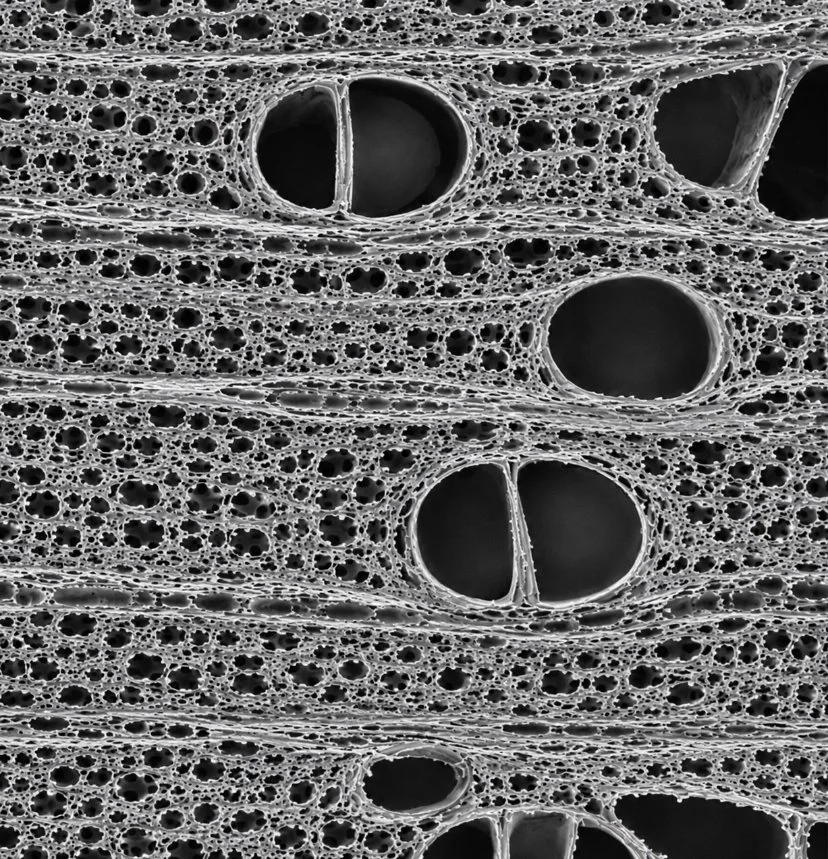
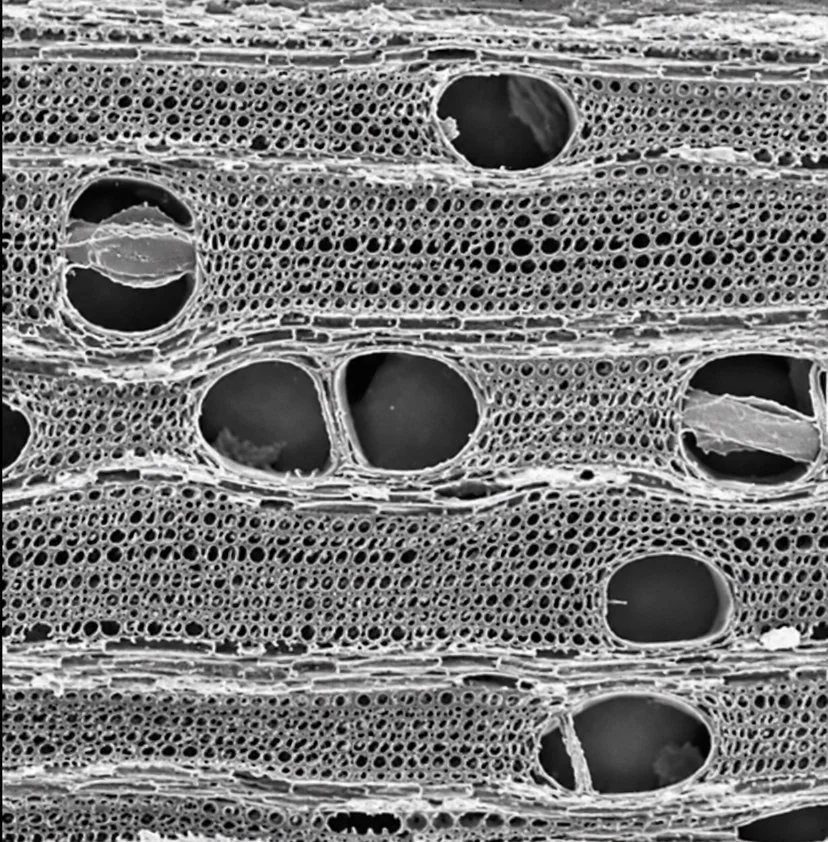
Two scanning electron microscope images of the same species, at comparable magnification. On the left, the untreated wood is veiled, its walls still coated in natural oils and extractives. On the right, the XCD-treated wood reads open and cleared — the cell-wall structure exposed, ready for resin to bond directly to the cellulose rather than to a film sitting on top of it.
Four stages, one block.
Rough Selection & Drying
Blocks are cut oversized and vacuum-dried to 0% moisture content before any treatment begins. Nothing is left in the wood to compete with the resin for space.
Cavitational Cleaning
A cleaning fluid is driven deep into the wood's cell structure. Cavitation physically dislodges the saps, waxes, oils and terpenes trapped in the micro-capillaries and pit membranes — the same extractives that normally block resin from penetrating in the first place.
Molecular Exposure
With the extractive layer gone, clean cellulose and hemicellulose are exposed — the polar, high-energy surfaces that resin can actually wet and grip. Delipidation doesn't just clear the pores; it changes how the wood accepts resin at the wall.
Resin Infusion
Under deep vacuum and high pressure, our custom stabilising resin is driven to the core — reaching cleaned cell wall surfaces that stay closed to a standard soak. A special component of the resin forms a covalent bond between the cellulose and the cured resin, a chemical bond, not just a fill. The result is inter-penetration through the structure rather than resin loosely filling the larger pores.
What XCD changes, cell by cell.
The same XCD-treated cross-section from above, marked up to show what's actually changed. Zoom in for a closer look at the cell walls themselves.
What XCD-treated timber gives you.
Stability
Most stabilised wood that eventually warps isn't failing because of the resin — it's the weak boundary at the cell wall, where resin met an oily surface it could never properly grip, that moisture slowly breaks. XCD removes that boundary before resin ever goes in.
Permanence
Because bonding happens at clean cellulose — hydrogen-bonded and covalently grafted — rather than against a contaminant film, the bond is built to hold over years on the bench, not just through the first polish.
Predictability
Natural wood swells and shrinks with humidity. By bonding resin into clean, exposed cell walls, XCD-treated blocks are engineered to behave far closer to a stable, dimensionally consistent composite than to raw timber.